 Theology
Ministers and AI Study Tools
A minister reflects on why AI belongs in the pastor's study — not as a shortcut, but as a force multiplier for those with the formation to use it wisely.
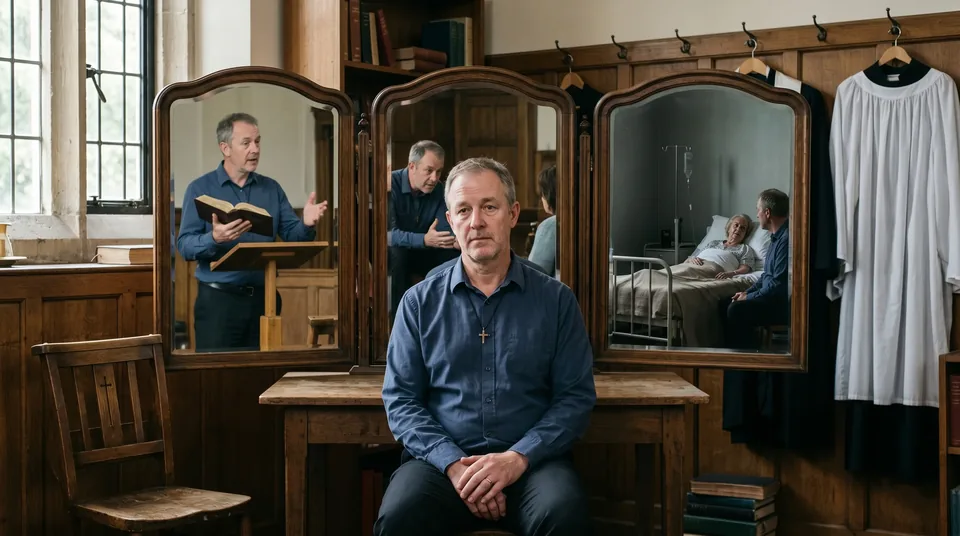
I've been a minister since 2014, and somewhere along the way I spent close to $45,000 on my Logos Bible Software library. That's not a flex — that's just what happens when you're a compulsive reader with a library problem. Most ministers I know study just as seriously with far less. But I say it to establish one thing: I am not a person who takes shortcuts with the Bible. Which is exactly why I now use AI as a regular part of my study workflow.
The Irony of the Current Moment
There's a pattern in Christian history that our critics have long pointed out. New technology arrives — the printing press, biblical criticism, radio, television, the internet — and a segment of the church pumps the brakes. The secular world calls it fear. I'd call most of it discernment. The church has a responsibility to evaluate what it adopts and why, and history has vindicated that caution more often than the critics want to admit.
That said, the charge of being reflexively anti-progress has stuck, fairly or not. What's interesting is that the secular world has now abandoned any pretense of being different. AI is where it's playing out loudest.
Everything generated with AI assistance is "slop." Every use case is either dangerous or intellectually dishonest. The nuance is gone.
According to society, quality doesn't matter; purpose doesn't matter — if AI touched it, it's suspect. AI code is slop. AI art is slop. AI music — some of the most technically impressive output the technology produces — is slop. AI video is slop. "Slop" has joined the ranks of words so overused they've stopped meaning anything. It now just means "I disapprove," which makes it useless as actual criticism.
I'm not here to defend bad AI output. There's plenty of it. But the reflexive dismissal of an entire category of tools, without regard for how they're being used or by whom, is exactly the kind of reactionary thinking the church has been mocked for. It turns out this isn't a Christian problem. It's a human problem — and the people who spent decades pointing fingers emphasized it again.
Why Theology Is Actually a Good Place for AI
Here's something that doesn't get said enough: historic Christian theology is one of the most stable bodies of knowledge that exists. The ecumenical councils settled the major doctrinal questions — the nature of Christ, the Trinity, the canon — centuries ago. The Westminster Confession, the Nicene Creed, the Apostles' Creed, the great confessions of the Reformation — these aren't living documents that get revised every few years based on cultural pressure.
That stability matters enormously when you're talking about AI and hallucinations.
AI hallucinates when it reaches the edge of what it knows and starts filling in gaps. The less consensus there is on a topic, the more opportunity for fabrication. But historic Christian theology? There is no shortage of consensus. Ask any major AI about the hypostatic union, justification by faith, or the attributes of God — you're going to get a remarkably coherent answer that lines up with what the church has confessed for centuries.
This doesn't mean AI is a theologian. It isn't. But it does mean that the hallucination risk that makes AI unreliable in cutting-edge research or current events is significantly reduced when the question involves settled doctrine that has been written about, debated, and refined for two thousand years.
I'd actually argue that you're more likely to get stable, historically orthodox theology from a well-prompted AI than from a lot of seminary graduates today. Machen was sounding the alarm about seminary drift before 1923. The problem didn't start recently, and it hasn't gotten better. AI trained on twenty centuries of confessional Christianity isn't going to spontaneously decide that the resurrection is a metaphor.
The flip side of this is worth saying plainly: the places where modern theology has become unstable — deconstruction, cultural revisionism, the slow replacement of exegesis with ideology — are exactly where AI gets wobbly too. The training data reflects the confusion in the field. Ask an AI a question about a contested contemporary theological controversy and you'll get hedging, both-sidesing, and the kind of studied ambiguity that passes for nuance in circles where no one wants to be wrong. That's not a problem with AI. That's a problem with the theology. It means knowing your confessional tradition before you prompt isn't just helpful — it's necessary. You need to know what you're looking for to recognize when you're not getting it.
Foundations Matter
The reason I can use AI effectively is that I have a foundation — and that foundation wasn't built by software. It was built by God-fearing men and women who taught me the faith, by years in the text, and by the kind of formation that happens in a church, not a classroom. I know enough Greek and Hebrew to catch a bad translation. I've read enough systematic theology to spot where something has gone sideways. I've preached long enough to know what lands and what sounds right but isn't.
AI without that foundation is genuinely risky. You can be confidently led wrong — but too many seminaries have been doing that particular job for decades with a diploma attached. The tool requires the user to have enough knowledge to evaluate the output, and that requirement doesn't go away just because the source has institutional credibility.
But with that foundation, AI becomes a force multiplier. I can generate a scholarly report on a passage that would have taken me hours to compile and get it in minutes — and I can evaluate the output because I know the tradition well enough to catch errors.
That's not a shortcut. That's leverage.
What I Will Not Advocate For
I will not now, and never will, advocate for AI pastors or AI-produced and delivered sermons. The ministry is not a content production pipeline. The relationship between a shepherd and a flock is not something a language model can replicate. Pastoral care, the kind that happens at 2am when someone calls because their marriage is falling apart — no AI is doing that.
The Word became flesh and dwelt among us. Incarnation is the model. Presence matters. The pastor who has walked through suffering with his people and opens the text on Sunday morning carries something that no generated output can substitute for. He has wept with them. He has sat in the hospital. He knows the name of the person in the third row whose marriage is barely holding together, and when he preaches on the grace of God, that room knows he means it. That is not a function. It cannot be automated. It is not a pipeline.
But that's a different argument than whether AI belongs in a minister's study. Of course it does. The question isn't whether to use powerful tools — it's whether you have the formation to use them wisely.
Don't Shy Away — Try It
The Anselm Project isn't a generic AI wrapper where you type a question and hope for the best. I built the pipeline around my own study pattern — the way a minister who takes the text seriously actually works through a passage. The reports reflect that. This isn't blindly asking AI to do your work; I built a process around it that I have to replicate every week for the sake of the church I serve.
If you've been hesitant because AI feels like a shortcut, I understand the instinct. Look at the Share Gallery and read what the reports actually produce. If it strikes you as shallow, don't use it. But if it looks like something that could extend your study in a useful direction — that's exactly what it's designed to do.
Refusing a useful tool isn't faithfulness. It's just stubbornness.
God bless, everyone.
References
New articles by email
Occasional notes on biblical studies, translation, and what’s new in the Anselm Project.