 Biblical Studies
The First Complete AI Translation of the Bible from Hebrew and Greek — and Why It's Auditable
Yes — a complete AI-translated Bible exists: all 66 books, translated from the original Hebrew and Greek, published October 2025. Here is how it works.
If you have ever typed "is there an AI-translated Bible?" into a search box, here is the direct answer: yes. The Anselm Project Bible is a complete AI translation of the entire Protestant canon — all 66 books, Genesis through Revelation, translated from original-language data rather than paraphrased from an existing English version. It went live on this site in late October 2025, and as far as I can determine it was the first complete one. It is free to read, no account required.
I want to lay out the record plainly, explain how a machine can be made to translate Scripture without cheating, and be honest about what this kind of translation is and is not.
The record
The APB was not announced once and left alone. It has a documented, dated history on this blog:
- October 2025 — the first complete APB went live: every book, translated pericope by pericope from the Hebrew and Greek, with morphology and variant renderings attached. I announced it here and, in early November, on Hacker News (the thread is still there).
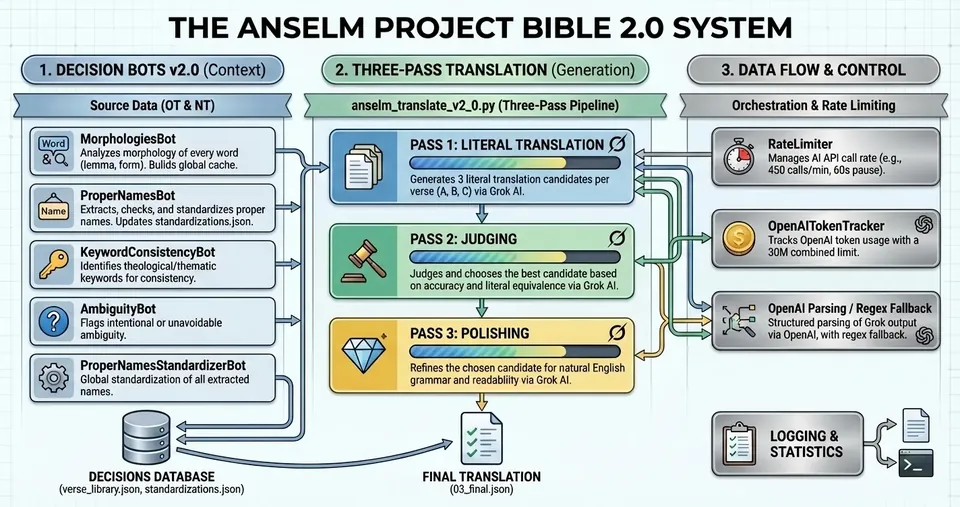
- December 2, 2025 — version 2.0: the translator went blind. The model was no longer told it was translating Scripture at all.
- June 5, 2026 — version 3: the full committee architecture, with an adversarial audit and deterministic publish gates, and an Audit panel in the reader so you can inspect the process yourself.
I keep the dates in front of me because the question of what came first turns out to matter to people — and because the answer is checkable, not claimed. If you know of a complete AI translation of all 66 books that predates October 2025, write to me and I will amend this post and the translation page.
What "from Hebrew and Greek" actually means
The APB is neither a restyled King James nor an English-to-English paraphrase. The Old Testament is translated from the Open Scriptures Hebrew Bible, based on the Westminster Leningrad Codex; the New Testament from the SBL Greek New Testament with MorphGNT morphological analysis. What the translating model actually receives is per-word data: the lemma, the parsed grammar, and lexicon glosses for every single word in the text.
That input format is the foundation of the whole claim. The design goal: every English word in the APB must be provably traceable to a source token. When there is no Hebrew or Greek word behind an English word, that is a defect, not a style choice, and there is machinery dedicated to catching it.
The part nobody warned me about: the model cheats
Here is the honest engineering story. When an AI knows it is translating the Bible, it does not translate — it remembers. It has read every major English translation, and under the surface it will quietly reproduce the traditional rendering instead of the text in front of it.
My clearest example is Mark 1:1. The Greek source data used by the pipeline does not include "the Son of God" in that verse. An earlier version of the APB rendered it anyway — because the model was reciting the Bible it already knew, not translating the tokens it was given.
Version 3 attacks this with two mechanisms working together. First, the translating stages are blind: they receive tokens, decoded grammar, glosses, and neutral structural instructions — never the words "Bible" or "Scripture," never a book name, never a verse reference. The model can often infer what it is reading; that is fine, because the second mechanism does not depend on the disguise holding. An adversarial audit stage back-translates the finished English and hunts for additions, omissions, and imported concepts. Any English word with no source token behind it gets caught and reversed — whether the model recognized the text or not.
One model, eight roles, and gates no AI can talk past
The engine behind every stage is Grok (grok-4.3, from xAI). But "Grok translated the Bible" would be the wrong headline. No single pass of any model produces this text. Human translation committees exist because no single translator can be trusted alone — so the APB borrows that discipline and runs one model as eight separated roles: a philologist produces a word-grounded literal reading; an annotator builds the apparatus; a translator drafts two independent candidates; a deterministic selector — code, not another AI's opinion — picks the lower-risk one; the adversarial auditor back-translates and hunts; a terminology editor enforces one spelling per name and renders the tetragrammaton "the LORD"; a stylist and proofreader clean up without changing meaning; and a deterministic publish gate blocks any pericope from going live until every verse passes.
The gates are the point. At the moments where a model might smooth over a problem — choosing between candidates, approving its own work — the decision is taken away from the AI entirely and given to deterministic checks.
What "auditable" buys you
Most translations ask for trust in their committee. That is reasonable — the great human translations have earned it. The APB asks for something different: no trust at all. In the reader, any verse opens into its original text, the parsing of every word, and the record of how the rendering was reached. The judgment calls are recorded with their alternatives instead of being silently resolved. When the pipeline had to supply a traditional verse from outside its base source inventory — Nehemiah 7:68 is the famous case in this project — that is marked, not hidden.
I wrote up the whole methodology in plain language on the new About the Translation page, including the questions I get most often.
What this is not
I want to be careful here, because there is genuinely good work happening elsewhere under the same "AI Bible translation" banner. Most of it uses AI to accelerate human translation committees, usually for languages that still lack any Bible — drafting so that human translators do not start from scratch. That work matters enormously, and the APB is not in competition with it. There are also other LLM-produced English translations now, which I take as evidence the idea was worth having.
The APB answers a different question: not "can AI help humans translate faster?" but "what does it look like when an AI committee translates the whole canon under deterministic checks — and shows every receipt?" It is an experiment in radical transparency at a scale no human committee could publish. It is not a claim of superiority over the translations you already love. Every rendering carries its source tokens and reasoning in the reader, where anyone can check it.
Read it yourself
The whole point of an auditable translation is that you do not have to take my word for any of this. Open the Bible — all 66 books, with parallel Hebrew and Greek, synced audio, a lexicon of every word in the canon, and an atlas of every place. Free, no account.
References
New articles by email
Occasional notes on biblical studies, translation, and what’s new in the Anselm Project.