 Product Updates
Anselm Project Bible v3 and Site v5
Anselm Project Bible v3 and site v5 are live — a role-separated committee translation with an inspectable Audit panel and all-new eight-section commentary.
Version 3 of the Anselm Project Bible is live today alongside the fifth redesign of the site, and I want to tell you what it actually is — because the short description does not do it justice.
The APB is, as far as I can determine, the first AI English Bible translation produced from Hebrew and Greek source data using a role-separated simulated committee rather than a direct verse-by-verse prompt. That distinction matters more than it might sound, and the version in the reader right now is the most complete expression of what that approach can produce. It took 634,907,524 tokens across the full version 3 build to get here. The platform has now crossed 1.1 billion tokens in total — that figure includes the research reports users generate, because the system counts all of it — and it is still climbing. This is the largest update the platform has seen since it launched.
Why the Committee Approach Changes Everything
Every other AI Bible translation project I am aware of works the same basic way: take a verse, send it to a model with instructions to translate it, collect the output. That approach has a fundamental problem that no prompt can fully fix. The model knows what it is translating. It recognizes the names, the syntax, the famous phrases — and when it recognizes them, it drifts toward what it already remembers rather than what the supplied source text actually says.
The clearest early example of this in my own work was Mark 1:1. The phrase "the Son of God" is textually contested, and the Greek source I was using excluded it. The translation returned "the Son of God" anyway. The model recognized a familiar pattern and filled in what it expected to be there. First Corinthians 7:36 has the Greek word ὑπέρακμος, which carries the sense of being past one's prime, beyond the proper time. English Bible tradition reaches for "the flower of her youth," and the model kept wanting that interpretive world even when the supplied evidence said otherwise. It was not translating the word. It was translating the tradition around the word.
Stronger prompts helped but could not solve it. A model that recognizes ancient names, biblical syntax, and famous phrasing is going to infer the context regardless of what the instructions say. So version 2.0 stripped the canonical framing from the prompts entirely — no book names, no genre labels, no verse references — so the model received ancient-language text and structural instructions without the cues that invite it to quote from memory. The output got more literal and in places clunkier. At that stage, clunkiness was evidence the system was working.
The APBv3 committee architecture takes this further. Instead of one model doing everything for each verse, distinct roles handle different aspects of the work: philology, the textual apparatus, translation drafting, candidate selection, adversarial audit, name and terminology policy, style editing, final proofing, and release validation. No single model carries the whole process, because a single model carrying the whole process is exactly how you get output that sounds fluent while quietly substituting memory for evidence.
The morphology layer has its own story. The in-house parser I built for earlier versions produced plausible-looking data with enough errors embedded that I could not trust it for the inspection layer. Since the whole point of the APB is that you can open a verse and trace any translation choice back to the source, bad data in that layer is a worse problem than awkward prose. Version 2.5 replaced it with the Open Scriptures Hebrew Bible, based on the Westminster Leningrad Codex, for the Hebrew, and MorphGNT tied to the SBLGNT for the Greek New Testament. Using data already trusted in the field was more important than having built it myself.
The final structural change that made completeness a hard requirement rather than a hope was verse-addressed segment enforcement. Earlier systems could translate a passage as a block and trust later code to divide it into verses, which meant a partially translated passage could still look finished. APBv3 maps every source row to a unique segment ID and requires a non-empty English result for every expected segment before anything assembles. Missing segments, duplicates, empty outputs, malformed structures, and suspiciously short translations get rejected or escalated. This is how I caught the most serious problem late in the audit: John 7:53-8:11 was missing entirely — not a translation failure but a source-inventory failure, because my local MorphGNT snapshot predated the Faithlife update that added those rows. A translation can be complete against its own source inventory and still be incomplete as a public Bible, and the segment enforcement system is what surfaced that distinction. The final release added a textual supplement and versification-repair layer for those and similar cases. Final base translation engine is Grok 4.3.
The Commentary
The translation is what the project is named for, and it is where most of those 634,907,524 tokens went. The commentary is a significant portion of that total, and it is entirely new in this version.
Every pericope in the reader now has eight commentary sections. The first is an overview — the orienting summary of what the passage does and where it goes. The second is an introduction that describes the passage's setting, the central tension that drives it, and why it matters in its immediate canonical context. The third situates the pericope within its book: what came before it, how it connects to what follows, what recurring patterns in the larger book it advances or introduces.
The fourth section covers literary shape — the structure of the passage, the patterns the author uses, the rhetorical moves visible in the text. For Genesis 1:1-2:3 that means the command-execution-evaluation-day-close pattern that runs through the six days, the notable absence of a goodness declaration on Day 2, the shift on Day 6 to a plural address and an expanded blessing that moves through the food assignment and closes with "very good" rather than "good," and then the break in the established pattern on the seventh day when no new command appears and no evening-and-morning formula closes the sequence. The literary shape section is not literary criticism for its own sake. It is the kind of observation that keeps a reader from missing what the text is doing.
The fifth section covers historical and cultural background. For Genesis 1 that means the ancient Near Eastern picture of a watery, unordered beginning before creation, the echo of Mesopotamian terminology in the Hebrew word for the deep, the ancient image of the sky as a solid barrier holding waters above, and the widespread ancient practice of royal image-setting — kings placing statues of themselves in distant territories to represent their authority — that the text draws on when it speaks of humanity created in the divine image and given dominion, applied here to male and female together without reference to royal office or temple installation. This section does not try to resolve creation-science disputes or import modern controversies into the ancient text. It supplies the world the original writer and first readers inhabited.
The sixth section covers theological themes — what the passage is actually claiming and how those claims fit the larger theological structure of the canon. The seventh covers interpretive issues: the genuinely open questions that serious readers have divided over and that the text itself does not settle. For Genesis 1 those include the relation between verse 1 and the formless condition described in verse 2, whether the opening sentence is a complete assertion prior to the sequence or a heading over it; the identity of the plural "us" in verse 26, which the narrative does not explain and which later readers have handled in several directions; and the deliberate silences the passage maintains on the mechanism of creation, the explanation of the initial unordered state, and the immediate implications of the seventh-day rest for human practice. The interpretive issues section does not pretend these questions have obvious answers, and it does not paper over the places where the text is genuinely open.
The eighth section is passage movements: a unit-by-unit walkthrough that works through the text in sequence, tracking what each unit contributes and how it connects to what comes before and after. For a longer or more complex pericope, this is the commentary equivalent of working through the text with a good study Bible open — except organized around the natural divisions of the passage rather than verse by verse.
That is one pericope. Every one of the 2,058 pericopes in the APB has all eight of these sections.
The book commentary runs separately from the pericopes and is accessible from the Study button at the top of the reader. It covers nine sections: an overview, an introduction to the book, authorship and tradition, occasion and setting, literary design, historical context, theology and themes, canonical witness, and a reading guide, plus a structural outline and key terms. The Genesis book commentary covers the recurring "these are the generations" formula that architectures the entire book; the literary design of the patriarchal cycles and the way the repeated pattern — promise spoken, immediately endangered, preserved through unexpected reversal — functions as character development rather than simple duplication; the theological thread of divine faithfulness running through human failure from the flood through the call of Abram through Jacob's deception through Joseph's suffering; and the canonical witness of later Scripture to the Genesis narrative, from Exodus through the prophets into the New Testament. The reading guide addresses specifically how to read the book without flattening it — not a moral sourcebook, not a seamless historical chronicle, but a sustained narrative whose governing tension between divine purpose and human resistance is the whole point.
This runs from Genesis to Revelation.
The Audit Panel
The Audit panel is a button at the top of the reader. Opening it overlays the passage with a full breakdown of the pericope's translation process — four summary cards covering source text alignment, the Grok 4.3 translation engine, terminology and name standardization, and editorial finalization. Below those, a set of expandable Audit Details shows the two committee renderings (Close Readable and Clear Formal), Rationale Notes explaining why specific phrases were handled as they were, the full Terminology list of Strong's-keyed translation policies applied to the passage, any logged Repairs, and Word Glosses across all source terms. Dismiss it with ESC and you are back in the text.
Textually contested passages are labeled honestly. John 7:53-8:11 — missing from my source snapshot because my local MorphGNT file predated the Faithlife update that added it — comes from the official Faithlife/SBLGNT v1.2 bracketed main text and is labeled as such. Other traditional verse slots drawn from the SBLGNT apparatus, from versification splits, or from the parallel Ezra source in the case of Nehemiah 7:68, are noted with where they came from and how they were produced. Pericopes with supplemented verses report "Grok 4.3 Base Translation; APB Editorial AI Supplements" rather than presenting a uniform base translation for material that came from a different process.
The reason the Audit panel matters is the alternative: a translation that presents itself as authoritative and asks you to trust it because the output sounds right. That is not a sufficient reason to trust a Bible translation. If a parse is wrong, if a terminology decision is questionable, if a supplement came from a different source than the main text — all of it is visible. A translation you can inspect is a different kind of object than one that simply shows up finished.
The Redesign
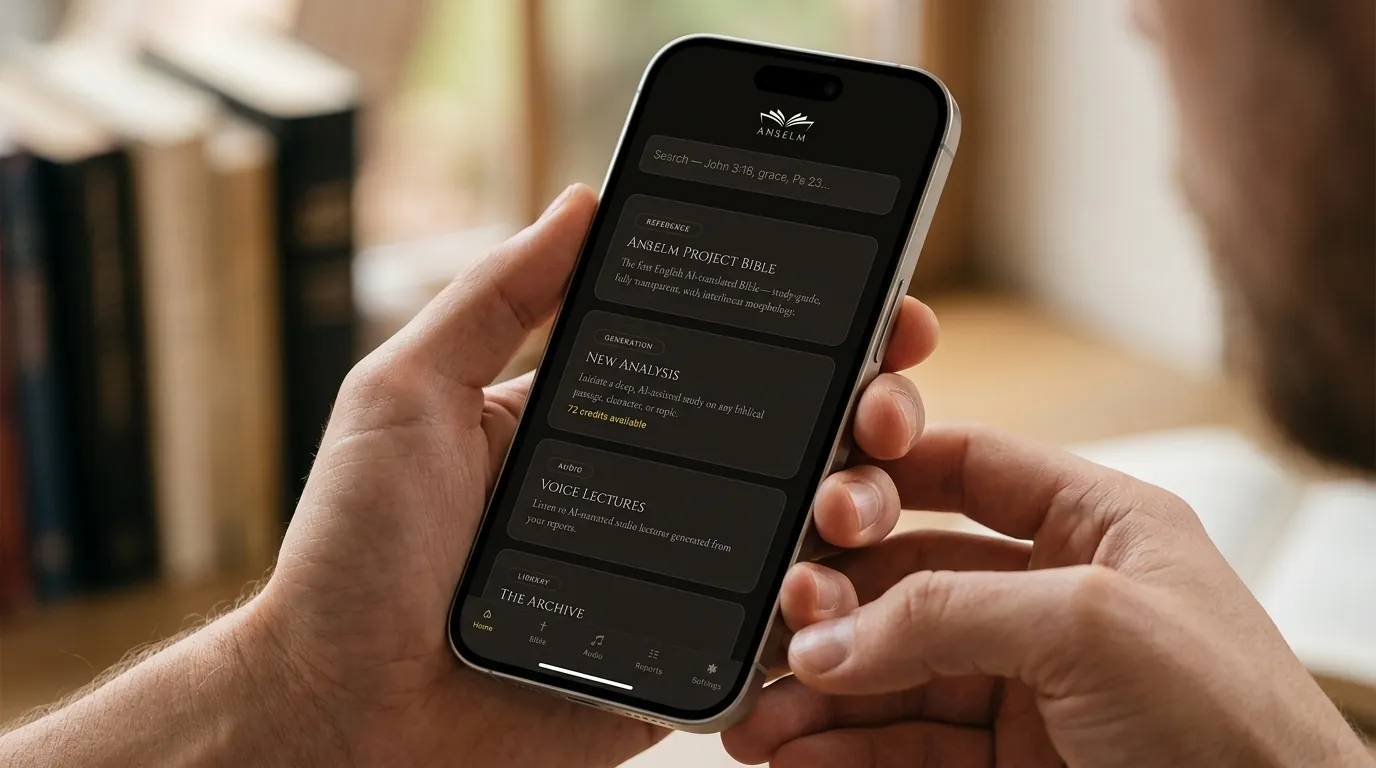
Version 4 launched in April and lasted about seven weeks. It did the job but it was too busy — too much visible at once, not enough put away. Version 5 is what I actually wanted: cleaner, prettier, with the things you do not need constantly in front of you tucked into drawers and panels that are easy to reach when you do need them.
The redesign is not just the reader. The whole site got rebuilt — the blog, the navigation, the overall aesthetic. The direction moved somewhere more editorial and less like a dashboard, which is where it should have been from the start. A platform built around serious engagement with Scripture should look like it takes the subject seriously.
The Share Gallery is still there if you want to see what the platform produces beyond the reader — character studies, passage reports, topical studies, Apologetics, The Synod.
Come Have a Look
There are 2,058 pericopes, 66 books, and 634,907,524 tokens of work in this version, and I cannot review all of it to the standard I would want. Something has slipped. A parse that went wrong, a commentary section that drifted on an interpretive question, a verse the reader is not handling correctly — any of that is possible at this scale, and I would rather know about it than not.
If you find something, file it at the support page and I will look at it. That invitation covers substantive scholarly feedback as much as technical errors. If the historical background section on a passage is missing something important, or the interpretive issues section handles a question in a way that strikes a serious reader as wrong, that is exactly the kind of feedback that makes this better.
I'm happy with what version 3 is. Go look at it.
God bless, everyone.