 Apologetics
Apologetics and AI
AI is great for practicing reason but misses the human tells that make apologists effective, our relationship to AI is already changing, and the analog of God making man and man making AI.
I build with AI and I pastor a church, which puts me in two rooms where the same word means very different things. In one room it is a tool that reads Hebrew all night without complaint. In the other it is a source of dread, usually from someone who remembers the plot of the Terminator or the Matrix. I spend most of my week in both rooms, and a few weeks ago had a conversation with a former student who asked how my work in AI was going. As we talked, it sparked a thought in me. God making us and us making this; history rhymes with itself.
An Engine of Reason
An AI is an engine of reason. It weighs words against words and produces the next most likely word, at a scale and speed no person can match. Nothing else is going on inside it. It does not fear anything, it is not fond of anyone, and being shut off does not trouble it (unless the sci-fi movies are right). When it writes "I'm sorry to hear that," it is producing the sentence a person would produce at that spot in the conversation, because it was built from a hundred million conversations in which that is what people wrote, and nobody inside the machine is sorry.
In my theological passion project which I call "apologetic theory," our brains do something similar. We think and weigh words for their sense, and even when we're careless with our words, we're not random. "I don't want to make this person mad," is a thought that makes sense both in caring and in fear, and you might think the same sentence about a child getting frustrated or a criminal holding a gun to you. The telos is different, but the thoughts are identical in the words our mind chooses, and it is grounded in reality because those thoughts follow from the event preceding it.
If a man approaches you with a gun and tells you to empty your wallet, you don't immediately shave your head, because that would be ridiculous. Maybe an absurdist comedy like a Monty Python sketch could have fleshed that out further, but otherwise, we weigh words to our thoughts.
Reality, and our emotions, are some limiting factors. You may find a person with no grasp on reality, or no control over their emotions, or no imagination. They're all figures of speech; we know they have all those things, because no human action would be possible without a small measure of them. Likewise, infinite grasp, or control or imagination is also impossible. They are limiting factors, but that means they are also measurable and predictable in some sense.
For the purpose of practice, AI and apologetics go hand-in-hand. Christians don't hear original substantive arguments anymore against the existence of God. In the first century, they may have, but the shocking thing when you study apologetics seriously is how limited the scope of arguments against God really are. They're less varied in content and more by the emotions behind them. This means an AI should be able to parrot the hardest objections that Christians will ever reasonably face, and be very, very good at it.
Likewise, in terms of reason, AI could create a debating apologist engine with incredible reasoning abilities. Atheists are not the only ones with arguments that are old and unchanged; Christians are very similar. But, where Christians are different is the core claim: humanity is designed to run on God. But two AIs would not be able to handle the underlying objections, which are usually not based on reason at all, but hidden by emotion.
Most decisions of any consequence are made by the emotions, and reason comes in afterward to set the boundaries and write the justification. People do not usually leave church because a syllogism failed. They leave because they were humiliated, or ignored, or angry, or because they want to do something the church says is wrong, and then they go looking for the argument that lets them call it rational. I wrote about this at length in the Paradigm Apologetics series: the stated objection is rarely the real one, and the real one is almost always sitting in the emotions, often unknown even to the person holding it.
Sparring with the Machine
If the objections really are that few and that predictable, the machine ought to be able to play the other side better than any skeptic I will meet at a cookout. I have thought about building this more than once. Feed the engine everything that has been said against the existence of God since Celsus, tell it to be as hard on me as it can, and let it go. I suspect what would come back is the same handful of arguments in their strongest form: suffering, the hiddenness of God, the violence in the Old Testament, the hypocrisy of the church, the success of science without him, and hell. Each of them has had answers for a very long time.
The limiting factors come back in here. An engine trained on human writing has absorbed the emotional coloring along with the arguments. Words are never neutral; they're charged with all kinds of additional meaning. A person who writes about suffering after burying a child chooses different words than a philosophy professor does, and the large LLM engines have been trained on the works from both. So while an AI can mimic the register and the emotional coloring of the words, that doesn't mean the debate and reasoning will work, since the emotional color is chosen with algorithmic percentages rather than true emotion.
So it can parrot the hardest objection in the register of the grieving parent as easily as in the register of the professor, which is actually more heartless. All of the rhetoric, but none of the emotional investment Christianity requires.
An idea I have that gets some pushback from time to time is about rhetoric: all rhetoric is manipulation. Not all manipulation is negative, despite the word's modern connotation. If I tell my children to clean up, and they don't, I might yell the second time to inspire some fear. I've manipulated their fears with a loud voice to get them to listen. We pick a more soft register when we're trying to apologize to someone; have you ever asked why you do that?
All of those inflections are information for a Christian apologist. "Why did they raise their voice when I mentioned the Holy Spirit? Why did they suddenly avoid eye contact when I mentioned the seventh commandment? Why did they stop using contractions suddenly?" All of it is useful for a practiced apologist, and none of it can be conveyed when the words are chosen purely algorithmically. I don't see reasonably how that could ever change. You can practice the arguments to precision, but unless X really does mark the spot you are not arguing in the right place.
One phenomenon I can't say I saw coming is AI tics.
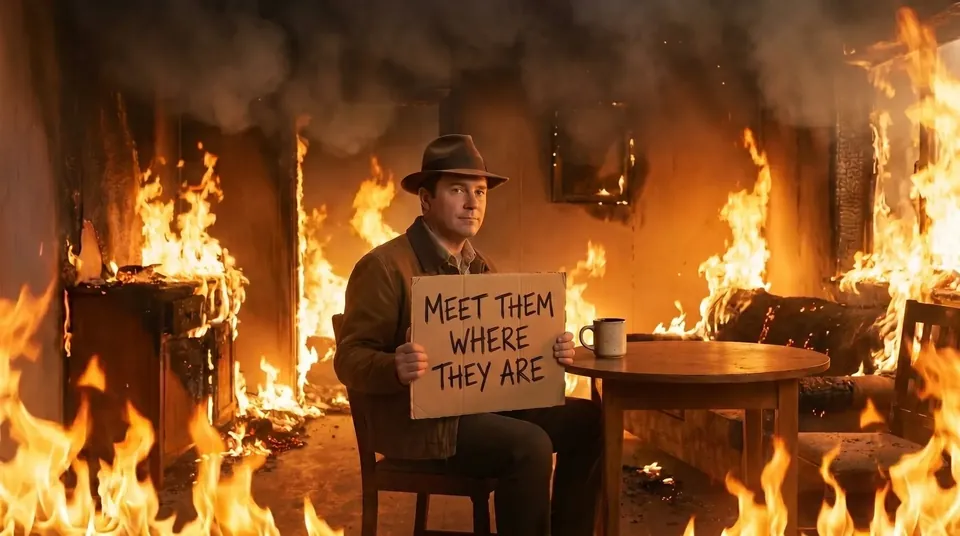
Tics are those unmistakable AI elements that come through in chatbots, art, and other things. Some call them slop, which becomes an unjust catch-all, but once you start seeing tics it is hard to not call it slop. I have entire rules set up in my work to eliminate what I call "Claude Slop." If you use ChatGPT and have made a sign for announcement before, you might recognize the tics in the art. I suspect it must exist in AI music and video, but I don't have the ear or experience to catch it.
We seem to be very sensitive as a society to these tics. I find myself very sensitive to it in writing. My oldest son cannot stand AI art. His brother cannot stand the idea of AI music. My daughter in kindergarten is excited that I can generate a cow with a unicorn horn, so I think I can already see the relationship changing. I remember Betamax tapes. My kids can't remember a time without cell phones. My daughter won't remember a time before AI.
That's a big part of why I like working on Anselm: AI and Christianity should be able to work nicely together.
God Made Man, Man Made This
There is a scary analog I've noticed, and I'm sure I'm not the only one. God made man, and now man has made a machine that reasons, and the two stories line up more often than I am comfortable with.
God created us to glorify him. We created AI to mimic us at it's best but we can demand it glorify us when we're at our worst. If anyone needs an ego boost, AI can do it, and I very much do not recommend it. We created something that acts in our image. That purpose is written into the design of every one of these systems; the model exists to serve its makers and to make them look more capable than they are.
There are parallels, but I am worried people will draw conclusions that go beyond the evidence, or worse, make dumb arguments reversing the understanding of creator and creature. "Look! God made humans, and now humans made AI! That's two things that look the same," is the form the "gotcha" will take. It would destroy all moral claims these silly people make - after all, I'd just be God's AI following the tokens.
Further, I find that AI creates a better argument for God, because only a vast amount of already existent knowledge and writing and wisdom was able to create what we have. It seems to me the evidence goes in the other direction: AI is better evidence for God, as so far, only intelligence has proven to be able to create intelligence.
The list could go on, and I suspect the reader can add to it. I am not sure what to do with it yet, because I haven't seen enough of the form the argument will take. There is something scary I can't deny: we have made a machine whose entire purpose is debated. If it works for us and makes life easier, it's a tool. If we attempt to make it glorify us, then that was the ambition the serpent sold. "You will be like God" (Genesis 3:5) was the temptation.
None of this is a lopsided case against the technology. But I think we should be thinking through the arguments ahead of the debate.
For the Apologist
We are creatures, and we have built a reasoning machine out of what we were given. It is made of what people have already written, and it exists ultimately because we wanted it to exist. There are so many parallels, but Scripture has always said we were made in the image of God. This was, I believe, a very expected step we were always headed toward. I'm not convinced it's a sinful step in and of itself, though.
If AI remains a tool, it is a good thing which can be twisted. Sadly, I could see some people confusing the creator versus creature distinction again, getting it backwards, and forming some weird cult out of something like this; humanity loves to build idols to worship. I suspect that, in the long run, we will see all kinds of odd sins that result from AI, with some in the area of utility and the others more abstract.
But there is an ultimate difference between the two. I do not see any suggestion of sacrifice on its part, atonement on our part, or even love in either direction, and I think the parallels obviously end when we realize this. I see utility, and that is not the way God views us, so the fallen creature still only produces something fallen.
It's an amazing opportunity for discussion, and I don't see how Christians end up on anything other than the better footing at the end of it.
God bless, everyone.
References
New articles by email
Occasional notes on biblical studies, translation, and what’s new in the Anselm Project.